
Connections
Introduction
Here we introduce you to the idea of networks, where we begin by explaining graph networks. This website is built upon this idea, where each of the pages is a network hub, hubs of information, which are connected together through the links. Each topic is built from the top down, through increasing amounts of knowledge on each subject, where a simple outlines become increasingly complex as you move forward.
This is very much like the layered nature of neural networks, networks that human brains are built upon (and also AI algorithms), where information is accumulated and summed as the connections move to the next layer. The more you move down through those layers, the more information is presented, where any single topic will expand from a section on a page, to several pages, just as neurons do, the more of them employed upon a certain topic, the more granular the understanding of that topic. As you will see, these networks of the brain, are intrinsically entwined with other networks embedded within the environment, both the social environment and the evolving ecological environment that all living creatures are subject to. Intelligence does not just occur within the neurons of an organism, or that of a synthetic intelligence, but within ALL of life as life interacts with itself, even down to the life that exists within us, the microbiota. You might also want to take a look at the Environments section to see how these dynamic systems interact.
Graph Networks
Graph Networks
Graph networks are a way of representing connections between objects. In their simplest form graph networks can be considered as a map, represented by points connected together by lines, which could be the roads connecting to places. In graph networks these points are called nodes while the connecting lines, the roads are called edges.
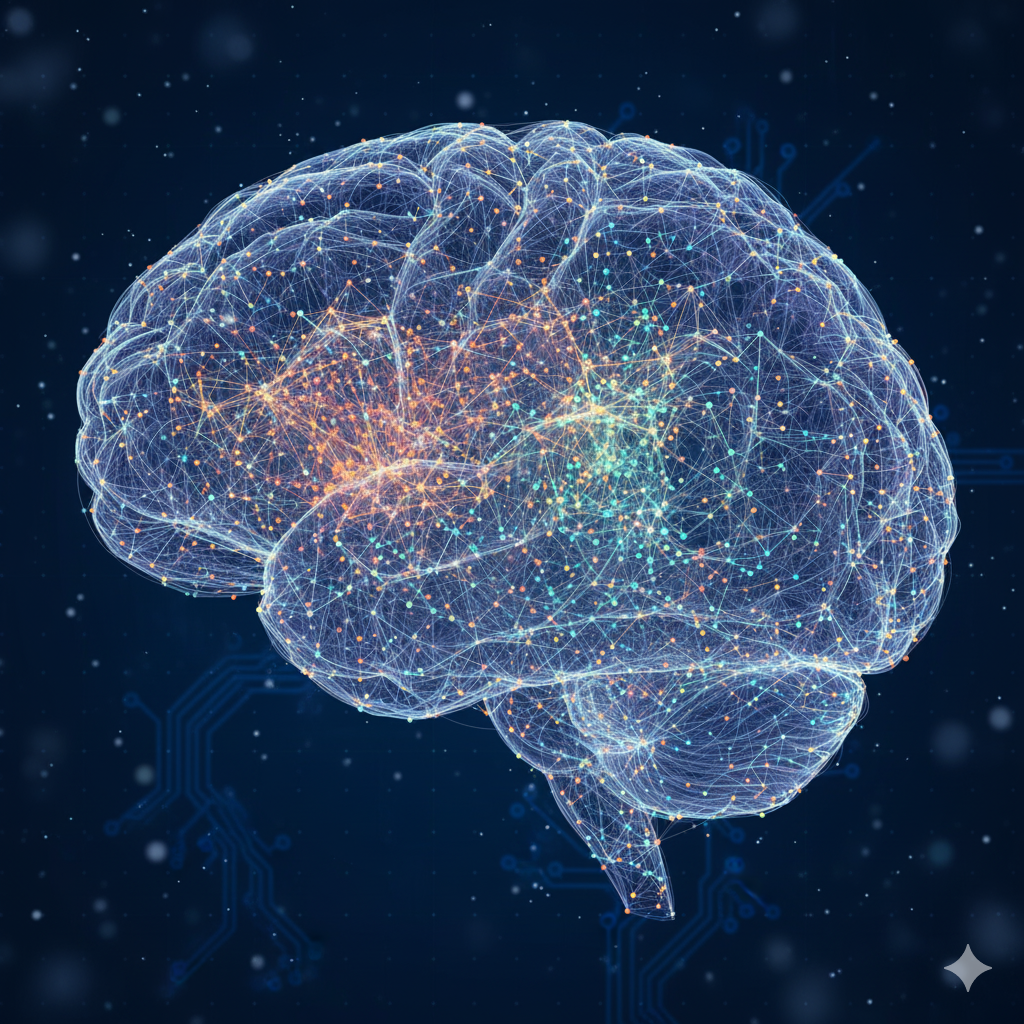
Graph networks can represent more than places, they can also represent links between data, so they can also represent systems such as the brain. The brain is a highly complex network of interlinking nodes, neurons, and edges, the inputs and outputs of those neurons. The inputs being called Dendrites, while the outputs are called Axons.
Graph networks are a great way of simplifying and visualising how different things are connected, and what they’re connecting to. When we consider maps as only places and roads, there seems to be very little information in the system, but when we consider the dynamics of each of the places, then things get a lot more intelligent. In this section we will expand upon these ideas.
The Graph Nature of this Website.
As presented in the Introduction, this website is set out like a graph network or the neural networks, networks that brains are constructed from, as are all websites to some degree. But where it is the intention to highlight those properties on the website, so that the user gets to understand more intuitively how they function.
But the neural network that this website is based upon, is more specifically that of my brain, or at least those parts of my brain that thinks about intelligence and intelligent systems.
If it were your brain, or another person’s. it would have pages concerned with your thoughts, those predominant thoughts concerning your life and actions.
It might have pages about your family, your social life, your work, your hobbies and interests, your opinions and beliefs, the concerns of your nationality or ethnic makeup.
It might now be adding pages from my brain, through reading pages such as this one, you might even link to it from your website, creating and edge or connection.
In effect, I’m now adding nodes to your neural network, and making connections between diverse subjects, subjects that I feel relevant to understanding intelligence and consciousness.
In truth, this is actually happening to the physical connections, connecting neural circuits to neural circuit. These connections are like the connections from webpage to webpage, links from information domain to information domain.
As you think more about the subjects presented here, and those thoughts take time on your conscious stream, your conscious network will become more and more like mine, more similar. This, I hope (if I have done my job well) will give you the ability to understanding these subjects and how they interrelate in more depth.
Networks of the Brain
Neurons can be thought of as trees, where the branches bring the information, the energy, of the outside world to the trunk, and where the roots talk to all of the other trees within the forest.
The brain is built from networks of interlinking neurons. But there are also networks upon networks, some connecting locally, while others connecting over greater distances. Some of those networks link throughout the body, what we know as the nervous systems. Knowing what each of these hubs specialises in is key to understanding how the brain functions and how our consciousness exists. Further to the connections, the networks of the brain function through the traffic that travels down those connections. Brain networks send traffic periodically, in the form of electrical charges, travelling down the Axons to connect with the Dendrites of one or many target neurons. These periodic pulses of traffic cause oscillations, where many neurons can keep in step with each other, almost as if they’re dancing together. You could think of this as like the traffic throughout the day, at night there is little of no traffic, so very little information is moved from place to place, while in rush hour, many people move from their dispersed homes, to dynamic places of work and learning. These in effect are oscillations, the traffic oscillates to pulse of the day night cycle. The interesting thing about this analogy is that this is very much what is going on in the heads of all the commuters. While they’re asleep, no data is being processed, and the oscillations are very slow, but when all those people wake up, the neural oscillations increase, as they have to process more information in regard to the environment.
Environmental Networks
Life on Earth is interdependent, that is that each life form has a place in the environment. These interdependencies create networks, complex structures of interactions. Each organism can be considered as a hub, an influence upon its environment, causing ripples of its actions to affect the space around it. This is a highly dynamic system, a system of chaos where some sort of evolving order exists. The environment was originally simple, with very few complex organism, causing very simple interactions. But as organisms evolved, their thoughts also evolved in step with the evolving environment, where this led to greater understandings in regard to the increasingly complex environment. Eventually this led to the evolution of the human brain, a dynamic learning system, that evolves on the fly, as the situation evolves in the short term.

Social Networks

Social networks are the way in which human intelligence functions, social networks are a sum of all of those individuals and their specialities, giving humans the abilities to adapt to the environment and adapt their environment to the benefit of all. But humans are not the only organisms that organise into social groups, many other animals do, and where socialising seems to lead to elevated intelligences. In deed species may interact socially, where each gets a benefit from the other. Humanities relationship with dogs can be seen as one such relationship. Although dogs are mostly used for companionship now, they evolved from wolves which are a pack animal, that may have originally scavenged off of humans, and where they protected small tribes of hunter gatherers, that were their source of food.
Questions
If AI’s have social networks, what advantages will they gain from those interactions?
Devoid of an environment of information, humans tend to exhibit psychological breakdowns. Where the mind has insufficient information, it tends to make up information to fill the void. Will AI’s in such situations also act accordingly?
Lorem ipsum dolor sit amet, consectetur adipiscing elit. Ut elit tellus, luctus nec ullamcorper mattis, pulvinar dapibus leo.
Lorem ipsum dolor sit amet, consectetur adipiscing elit. Ut elit tellus, luctus nec ullamcorper mattis, pulvinar dapibus leo.
Lorem ipsum dolor sit amet, consectetur adipiscing elit. Ut elit tellus, luctus nec ullamcorper mattis, pulvinar dapibus leo.